When reviewing a clinical trial budget, it is essential to thoroughly analyze cost details, minimize unnecessary expenses, and prevent budget overruns. Here are key aspects to consider:
First, ensure that all major cost items are included.
A clinical trial budget should cover personnel costs, site management fees, patient recruitment expenses, regulatory approval costs, investigational product (IP) manufacturing and logistics, and data management and analysis fees. It’s particularly important to confirm that a contingency buffer (typically 15–25%) is included to address unforeseen situations.
Second, carefully review the details provided by the CRO.
Check whether the CRO has clearly defined the scope of work (SOW) and whether costs are itemized. Ensure there are no hidden fees and verify that tasks between the Sponsor and CRO are not duplicated.
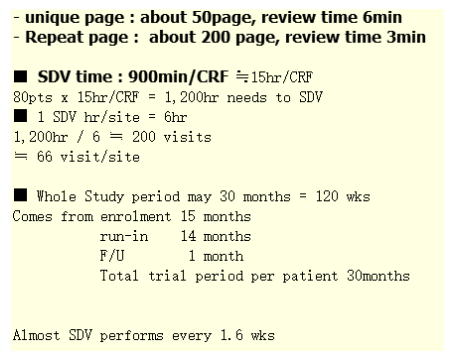
This will generate a draft number of possible monitoring visits. :)
Example:
Third, consider regional and country-specific differences in multi-regional clinical trials (MRCT).
Costs such as regulatory approval fees, personnel costs, and patient recruitment expenses can vary significantly by country. For example, personnel costs in Europe are generally higher than in Southeast Asia. Ensure these regional differences are accurately reflected in the budget.
Fourth, realistically evaluate patient recruitment goals and failure rates.
Patient recruitment goals and screening failure rates must be factored into the budget to adjust per-patient costs accordingly. Include allowances for potential over-enrollment or under-enrollment to account for associated costs, ensuring the recruitment targets are achievable.
Fifth, identify negotiable items.
Look for cost items that can be negotiated with the CRO. Overhead costs and fixed fees for specific tasks may offer room for negotiation. For example, request adjustments if patient recruitment costs or additional task charges appear excessively high.
Sixth, always include a contingency buffer.
Include a sufficient contingency buffer to account for risks such as protocol amendments, currency fluctuations, and timeline delays. This is critical to avoiding budget overruns.
Seventh, assess the efficiency of timelines and resource allocation.
Evaluate whether the timelines proposed by the CRO are realistic and whether resources are allocated efficiently. For instance, check if the frequency of CRA visits or data management hours has been overestimated.
Finally, compare multiple CRO budgets and select the most optimal option.
Compare proposals from several CROs to identify the most cost-effective and efficient option. Ensure the budget complies with regulatory and legal requirements and assess potential risks and cost overrun scenarios to incorporate them into the final contract terms.
By following these steps, you can review clinical trial budgets effectively, avoid budget overruns, and lay a solid foundation for efficient trial operations. If additional assistance or clarification is needed, feel free to ask.